By Joy Odor, Abuja
Nigeria’s health system entered a new and uncompromising era this week as the Federal Government sealed an historic communiqué endorsed by nearly 1,000 national stakeholders to execute the most far-reaching health reforms the country has attempted in more than a generation.
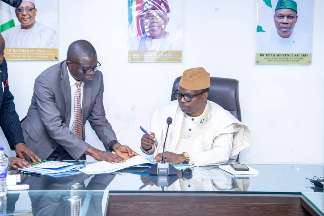
The 2025 Health Sector-Wide Joint Annual Review (JAR), which ended Friday with a Read Communique at the Transport Events Centre in Maitama, Abuja, did more than assess performance.
It issued a sector-defining blueprint that observers say could determine whether Nigeria finally breaks from chronic fragmentation or remains trapped in systemic decay.
Coordinated by the Minister of Health and Social Welfare, Prof. Muhammad Ali Pate, and Minister of State, Dr. Isiaq Adekunle-Sanakor, and attended by the DG of the Africa CDC, Dr. Tafer, the meeting drew an extraordinary coalition: Federal and State Executives, MDAs, Traditional Rulers, private-sector leaders, civil society, academia, global partners, and youth delegates.
One question dominated the hall:
How does Nigeria rebuild a strained health system under tightening fiscal pressure while advancing universal health coverage?
The communiqué, adopted by popular acclamation, attempted to answer exactly that.
For the first time, state-level JARs preceded the national review, marking a long-awaited shift to sub-national accountability something health experts have demanded for over a decade.
The Federal Ministry of Health confirmed three core outcomes: A nationwide performance review under the Sector-Wide Approach (SWAp),
A complete realignment behind the Health Sector Renewal Investment Initiative,
A renewed discipline of “one plan, one budget, one report, one conversation.”
But what shocked many was the breadth and boldness of commitments adopted.
1. A stronger Universal Health Coverage Compact
A new UHC addendum extends commitments to private sector players, LGAs, traditional institutions and non-health ministries creating Nigeria’s most inclusive health accountability structure.
2. Breakthrough gains in maternal and newborn survival
The MAMI programme recorded up to 17% maternal mortality reduction in early implementation of LGAs one of the strongest recent improvements in the region.
3. Nigeria’s first-ever open corruption dialogue in health
Ghost workers, irregular payments, poor fiscal tracking and double expenditures were openly debated no longer whispered.
Agencies now face newly mandated digital anti-fraud controls.
4. Deep immunisation audit
The expanded ICC session linked 2026 vaccine financing targets to hard fiscal realities ending years of aspirational but unfunded projections.
5. A national innovation arena
Over 45 exhibits showcased tools, dashboards, emergency systems and regulatory innovations, signalling a new era of local health tech competition.
6. Citizens finally take the microphone
The People’s Pulse Town Hall brought citizens face-to-face with policymakers, with raw feedback on cost of care, staff conduct, service quality and accountability.
7. Major national product launches
These include the: Health Sector Scorecard (HSSB), NHFR, NHMIS assessment, MSDAT
National CMONC readiness report
Climate & Health Adaptation Plan
Second National Action Plan for Health Security
All designed to move Nigeria toward a single source of truth for health data and decision-making.
The communique laid out painful realities: Less than half of states have functional coordination platforms.
Only 32% of facilities meet minimum emergency obstetric care readiness.
Rural staffing deficits remain severe.
Commodity stockouts and weak referral systems persist nationwide.
Budget delays and shrinking donor funding threaten core programmes.
Only 30% of BHCPF facilities offer full SRH services.
Immunisation performance remains mixed, restrained by fiscal pressures.
Nigeria’s health system is improving but far from safe.
1. UHC Compact Addendum to go live by Q1 2026
A co-developed implementation framework will include detailed ask-and-offer commitments and strict tracking mechanisms.
2. Biometric verification across all PHCs and insurance platforms
To eliminate ghost workers and strengthen HR accountability drawing on the Gombe model.
3. Full digital expenditure tracking by Q3 2026
All BHCPF-supported facilities must adopt biometric attendance and digital fiscal systems.
4. Data reform as non-negotiable
States must implement: Rigorous data quality plans, DHIS2 optimisation, and LGA-level data governance.
5. Workforce overhaul
A new national HRH programme will introduce future-proofed cadres, aligned with economic and service delivery needs, including value chain optimisation.
As the Communique circulated, the FG simultaneously unveiled a radical reform package covering climate, reproductive health, insurance, and local manufacturing.
Climate & PHC readiness
Nationwide scale-up of the climate-health (Miami) programme
Expansion of MPCDSR for nationwide maternal death surveillance by Q4 2026
Sexual & Reproductive Health Reset
Measures include:
Domestication of STOP, VAPP, TSTS
Constitutional review to reinforce women’s right to life
Full SRH integration into PHC and maternal care
Guaranteed SRH coverage under BHCPF
A lifecycle approach including post-menopausal care
Use of CSOs to challenge harmful norms
Insurance expansion
Mandatory employer insurance for all organizations engaging with government
Digital enrolment for equity programmes
5 million new enrollees by 2026, including 1 million vulnerable Nigerians
Industrialisation targets
By 2026: Five new medical manufacturing plants operational
20 priority commodities transitioned to local production
Vaccine procurement fully funded under AF 3.0.
The FG made it clear: Alignment is now mandatory. States must:
Mobilise domestic resources
Upgrade emergency response capacity
Meet minimum PHC readiness standards
Strengthen interagency coordination
Enforce DRF integrity
Comply with national health accounts and public expenditure reviews
Reforms failing at state level will jeopardize federal support.
In a meeting described as “unusually powerful,” the hall included: Ministers of Finance, Economy, Budget & Planning
Nigeria Governors’ Forum
36 State Commissioners for Health
DG, Africa CDC
WHO, UNICEF, Global Fund, GAVI
Traditional rulers’ delegations
Health Fellows
The communiqué was amended on the spot, and adopted without a single objection.
“I don’t see any violent objection,” the Minister joked.
“I’m not a legislator, I’m a doer.”
In closing, Pate issued heartfelt thanks to governors, federal agencies, partners, private-sector leaders, civil society, traditional rulers and youth delegates emphasising the urgency of the moment.
“This morning, I packed five development partners in my car and we rushed off,” he said. “Thank you for sticking with us.”
With the strike of the gavel, he declared the session closed. But the message was unmistakable: Nigeria is out of the runway.
The health sector must transform or collapse under its own weight.
For now, the coalition behind reform is not only widening it is solidifying.