By Joy Odor | Abuja
The race to shape Africa’s next digital powerhouse accelerated sharply on Thursday as the European Union unveiled a fresh €45 million investment to turbocharge Nigeria’s digital economy closing a major phase of its €820 million Digital Economy Package and solidifying what officials in Brussels called “one of the EU’s most consequential digital partnerships on the continent.”
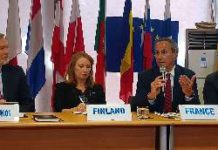
The signing took place at the EU–Nigeria Digital Open Day in Brussels, where Nigeria’s Minister of Communications, Innovation and Digital Economy, Dr. Bosun Tijani, and the EU Commissioner for International Partnerships, Jozef Síkela, executed the landmark agreement.
Diplomats and industry analysts present at the ceremony described it as “a turning point that redraws the map of digital infrastructure and talent investment in West Africa.”
Speaking moments after the signing, Commissioner Jozef Síkela delivered a forceful statement framing the partnership as central to Europe’s global digital ambitions.
“Global Gateway is about delivering new opportunities. Our cooperation with Nigeria has a strong potential to do exactly that,” Síkela said.
“Our digital approach is grounded in open standards, skills transfer, data protection and security. The new package will help modernise e-public services and prepare Nigeria’s youth for the digital future.”
EU officials highlighted that Nigeria home to Africa’s biggest e-commerce market and six of the continent’s eight tech unicorns has become an indispensable anchor for Europe’s long-term digital strategy in Africa.
Nigeria’s Digital Economy Minister, Dr. Bosun Tijani, positioned the agreement as a commercial and strategic win for both sides.
“This partnership reflects our shared belief that digital transformation must drive productivity and economic growth,” Tijani said.
“Project Bridge now offers a commercially sustainable entry point for European investors to participate in deploying open-access fibre at scale.
With our leadership in AI, Digital Public Infrastructure and the 3MTT programme, Nigeria provides unmatched opportunities for long-term investment.”
Industry insiders say the deal vaults Nigeria into the top tier of digital infrastructure destinations on the continent.
At the heart of the investment is Project Bridge, the most ambitious digital infrastructure programme ever attempted in Nigeria.
The EU grant will support preparations for an unprecedented 90,000 km fibre-optic backbone, backed by loans from the:
European Bank for Reconstruction and Development
World Bank
African Development Bank
When completed, the EU estimates that Nigeria’s total fibre network will expand to 125,000 km, a 70% increase making it Africa’s third-largest terrestrial fibre system, behind only Egypt and South Africa.
The €45 million grant is targeted at three critical fronts:
1. Detailed fibre-optic network design
2. Local skills development for engineers, technicians & digital operators
3. Supply-chain deployment leveraging EU private-sector expertise
EU officials said these pillars are essential to ensuring the country’s digital expansion is “technically sound, locally operated, globally competitive.”
Beyond infrastructure, the programme will help upgrade Nigeria’s public administration systems through secure, user-friendly digital services, aligning the country with Europe’s best practices in citizen-centric e-governance.
A significant portion of the funds will support Nigeria’s nationwide digital-skills pipeline critical for sustaining the massive fibre expansion.
EU officials emphasised that no large-scale infrastructure project survives without a skilled local workforce able to maintain and innovate on the systems.
The EU cited compelling metrics from Nigeria’s digital market:
Africa’s largest e-commerce hub with 87 platforms
2.9 million people employed in the digital services space
6 of Africa’s 8 startups valued over $1 billion are Nigerian
Lagos ranked as one of the continent’s most dynamic digital ecosystems
A senior EU official described Nigeria as “a unique blend of scale, youth, innovation capacity and policy momentum.”
The Open Digital Day served as a matchmaking platform for European investors and tech suppliers.
Delegates examined Nigeria’s €1.7 billion fibre expansion blueprint and explored partnerships in:
connectivity
cybersecurity
digital identity
cloud services
open-access infrastructure
e-governance platforms
Officials say the interest level exceeded expectations, with multiple EU private-sector players positioning for long-term market entry.
The Nigeria programme is part of the EU’s flagship Global Gateway Strategy, which aims to mobilise €300 billion in public and private investments between 2021 and 2027.
The strategy focuses on smart, clean, and secure connectivity across:
digital
energy
transport
health
education
research
Unlike traditional aid, Global Gateway emphasises long-term economic value, skills transfer and balanced partnerships.
Analysts say the deal accelerates Nigeria’s transition from an underconnected giant to a digitally enabled economic engine.
If Project Bridge succeeds, Nigeria will gain:
cheaper broadband
improved competitiveness
stronger e-governance
higher digital-sector employment
new FDI flows
reinforced regional leadership in West Africa
As one Brussels official put it:
“This is not just fibre. It’s the backbone of Nigeria’s next economy.”