By Joy Odor Abuja
In a rare and unfiltered message that cuts through diplomatic niceties, Marc Fonbaustier, the Ambassador of France to Nigeria warned that West Africa’s development trajectory is at risk unless governments urgently strengthen democratic institutions and restore public trust.
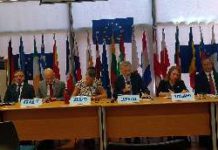
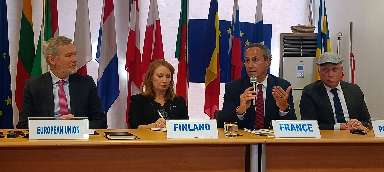
Speaking at a high-level media Luncheon hosted by H.E. Mr Gautier Mignot, EU Ambassador to Nigeria and ECOWAS and top Ambassadors of the EU Member States like France, Portugal, Finland, Germany, Italy, Poland, Sweden and Czech Republic in Abuja, the French Ambassador delivered one of the sharpest assessments yet of governance across the sub-region, stressing that no amount of aid or investment can compensate for weak institutions and failing accountability systems.
“Not many African countries are perfect democracies far from it,” the officials admitted. “But strengthening governance is essential. Citizens, especially the younger generation, expect more accountability.”
The EU drew a direct line between governance failures and the growing wave of military takeovers now destabilising the Sahel.
According to him, the warning signals were visible long before the coups erupted.
“We must respond early to governance weaknesses; we cannot wait until coups are already unfolding.”
The EU’s Member States message was unmistakable and arguably the clearest diplomatic call-out Nigeria has received this year.
Europe wants Nigeria to raise its governance standards, deepen institutional reforms, and position itself competitively in a global economy that is being rapidly rewritten by new trade blocs, shifting supply chains, and heightened transparency expectations.
Failure to adapt, Marc Fonbaustier hinted, could see Africa’s largest economy edged out in the next wave of global economic realignment.
With the EU recalibrating its footprint and seeking more reliable partners, Nigeria now stands at a consequential turning point: reform boldly or risk irrelevance.
The moment, European diplomats said, demands leadership not excuses.
EU Members State Ambassadors told Nigeria that the future of its trade, industrialization and investment prospects depends squarely on one thing: raising standards to meet global benchmarks.
They said Nigeria must accelerate reforms in product certification, sanitary and phytosanitary controls, and regulatory implementation if it intends to fully benefit from Europe’s evolving economic partnerships and emerging global value chains.
The EU official, responding to concerns about alleged trade restrictions against Nigerian goods, made it clear that the barrier is not geopolitics but quality control.
“The issue is not that something is banned or that Europe refuses Nigerian products,” he said. “The problem is standards mutual standards and Nigeria having a certification system that meets the minimum global requirements.”
He added that while there are isolated cases of resistance or rejection, the underlying challenge remains Nigeria’s capacity to meet modern sanitary and phytosanitary rules that determine what enters the global market.
The EU officials emphasised that Brussels is actively supporting Nigeria through technical assistance, expert missions and capacity-building to bring its certification systems up to global levels.
“We are already working with Nigeria to upgrade implementation,” he noted. “With the right experts on duty, the right sanitary systems and the right inspection processes, Nigeria can meet the standards required by trading partners.”
The EU added that both sides have trade barriers they must address but the priority now is to solve, not complain.
“Instead of lamenting that this product was rejected or that one was delayed, the question is: how do we fix the system so Nigeria can compete in global markets for years to come?”
In a major investment update, the EU revealed progress on a $2 billion logistics and industrial corridor project, with Nigeria positioned as a primary beneficiary.
Originally initiated with India and South Korea, and backed by G7 partners, the project is designed to transform regional transport, mobility and industrial operations.
According to EU officials:
Nigeria holds 51% of the corridor’s traffic potential,
High-level discussions recently held in Brussels attracted “several interested investors and operators”,
The project is being shepherded by the Ministers of China and India (as global partners), with Nigeria expected to advance negotiations in the coming year.
“This is an ambitious project, one of the most promising for Nigeria’s future connectivity and industrial expansion,” the officials said. “It is a foundation on which many more transformative projects could be imagined.”