By Joy Odor Abuja
In a charged end-of-year engagement in Abuja, the European Union delivered one of its bluntest messages yet to Africa’s largest democracy: upgrade governance, accelerate reforms, unlock economic potential or risk being sidelined in a rapidly changing global order.
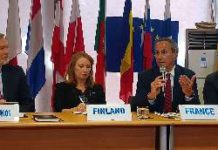
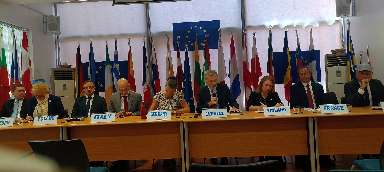
What began as a routine media luncheon quickly morphed into a full-scale geopolitical briefing as the EU Ambassador to Nigeria and ECOWAS, H.E. Gautier Mignot, flanked by Ambassadors of EU member states, laid out a sweeping review of the EU–Nigeria partnership from 2020 to 2025 and an uncompromising vision for 2026.
Referencing the fractious global climate, from economic shocks to political instability, Ambassador Mignot warned that Nigeria’s trajectory now carries regional and international consequences.
He recapped last month’s high-level summit between EU and African leaders a meeting he described as “significant and sobering,” given the rise of military juntas, collapsing institutions, and widening governance gaps across West Africa.
According to him, the EU’s renewed global strategy is built on transformative, sustainable partnerships, not transactional arrangements.
“We don’t just build infrastructure,” he said. “We build capacity, regulatory strength, and value chains that ensure Africa benefits from Africa’s resources.”
It was a subtle counter to China’s growing influence and a quiet declaration that Europe intends to reclaim strategic ground on the continent.
Mignot delivered a balanced but pointed assessment of Nigeria, describing it as “complex, challenging, and full of extraordinary potential.”
From entrenched poverty to rising inequality, from malnutrition crises in the North to promising growth in fintech and digital innovation, the ambassador insisted the EU sees both the cracks and the possibilities.
EU officials have now visited 16 different Nigerian states, a rare level of immersion for foreign diplomats and one that has shaped their tough-love approach.
The EU showcased a string of heavyweight initiatives, including:
€410 million Lagos electricity grid modernisation
€41 million health investment pipeline
€30 million culture and creative industry revitalisation
€100+ million security and development envelope
€50 million humanitarian funding for malnutrition and conflict-affected regions
These, they stressed, are only fragments of a much larger financial footprint Nigeria rarely recognises.
One of the EU’s most impactful pillars youth support was spotlighted:
Nigeria now ranks No. 1 in Africa for Erasmus scholarship beneficiaries
Over 1,000+ Nigerian startups have received digital and entrepreneurial training
The EU announced 25,000 new graduate fellowship slots, a scale never before attempted
The EU called it proof that its investments are “not just in buildings, but in human beings.”
In a region where coups are multiplying, the EU did not mince words.
“Governance failures are breeding grounds for juntas. We must act before coups erupt, not after,” the diplomats warned.
They confirmed new support packages for electoral reforms, women’s political representation, and counter-terrorism initiatives.
The message was unmistakable:
Africa’s largest democracy is too important to fail and too strategic to ignore.
The EU already Nigeria’s top trading partner revealed stunning figures:
€10 billion annual trade surplus in Nigeria’s favour
One-third of Nigeria’s FDI stock originates from EU companies
A new Nigeria–EU Trade and Investment Dialogue is targeting barriers that currently choke investment
For the first time, a dedicated working group will permanently track these challenges throughout 2026.
The ambassador outlined an aggressive 2026 agenda:
A high-level Nigeria–EU Ministerial Meeting
Acceleration of major Global Gateway infrastructure projects
A landmark €80 million gender-based violence intervention
First-ever Nigeria–EU Defence & Security Dialogue
Launch of a Science, Technology & Innovation Agreement
A new Migration & Mobility Partnership
A major EU–Nigeria Business Forum
Each initiative, he said, aims at one outcome: ensuring Nigeria rises to meet the demands of the new global economy.
In an unusually candid remark, Ambassador Mignot summed up Europe’s strategic interest:
“Nigeria must thrive because when Nigeria does well, Europe does well.”
He then opened the floor to questions, signalling a rare moment of transparency and accountability in one of the world’s most consequential diplomatic relationships.