By Joy Odor Abuja
A quiet farewell in Maiduguri on Thursday carried loud warnings for the future of humanitarian operations in Nigeria’s most fragile war zone.
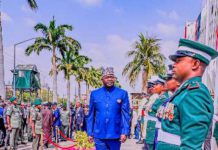
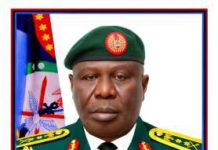
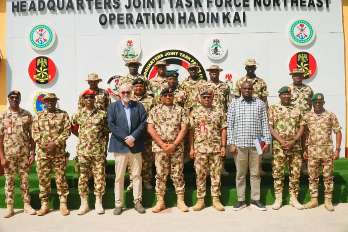
The Theatre Commander of the Joint Task Force (North East), Operation HADIN KAI, Major General Abdulsalam Abubakar, rolled out both tribute and caution as the outgoing Head of the United Nations Office for the Coordination of Humanitarian Affairs (UN OCHA) in Nigeria, Mr. Trond Jensen, took his final bow after years on the frontlines of the country’s humanitarian crisis.
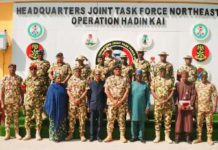
At the headquarters of the Theatre Command in Maiduguri, what began as a routine courtesy visit quickly turned into a strategic stock-taking of war, hunger, displaced populations, and the uncertain future of international humanitarian support in Nigeria.
General Abubakar described Jensen not merely as a UN official, but as a strategic ally in the military’s non-kinetic war the battle to stabilize communities broken by over a decade of insurgency.
“Your partnership has helped create the conditions for displaced families to return, for markets to reopen, and for children to return to school,” the commander said, praising what he called “a relationship built on trust, speed and mutual respect.”
He admitted that Jensen’s exit would be “deeply felt” within Operation HADIN KAI, given the scale of coordination between both institutions across conflict-ravaged communities in Borno, Yobe and Adamawa States.
But beyond the glowing tribute came a chilling warning:
UN OCHA plans to significantly scale down operations in Nigeria by 2028, not because the humanitarian crisis is ending, but because global donor funding is drying up.
General Abubakar did not mince words.
Such a drawdown, he warned, could cripple:
Malnutrition response programmes
Vaccination campaigns
Emergency relief for displaced populations
Rapid humanitarian access to newly stabilized communities
“The consequences will be severe if we do not act ahead of time,” he said, urging Nigeria to urgently prepare local funding strategies to fill the vacuum that would be left behind.
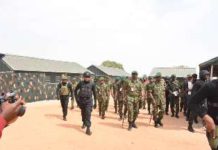
The Theatre Commander also revealed that military pressure on terrorists would intensify as the harvest season peaks, noting that joint operations involving OPHK and Agro Rangers are already targeting insurgent threats to farmlands and food supply routes.
“This is about protecting food security as much as it is about defeating terrorism,” he said.
In his farewell remarks, Mr. Jensen delivered one of the bluntest assessments yet of the global humanitarian funding crisis facing Nigeria.
“Our scale-down is not because conditions have improved,” he said. “It is because international funding is declining.”
He urged Nigerian authorities to:
Mobilize domestic humanitarian financing
Strengthen local emergency response systems
Sustain military protection of humanitarian workers and assets
Operating in what he described as one of the world’s most complex humanitarian environments, Jensen thanked the Nigerian military for securing life-saving operations in areas once considered inaccessible.
The departure of Jensen marks more than the end of a posting. It reflects a deeper shift in Nigeria’s humanitarian reality, one where:
Global attention is fading
Conflicts elsewhere are drawing donor funds
Local institutions must increasingly shoulder the burden
For the North East, where millions still depend on food aid, vaccinations and medical outreach, the transition is anything but routine.
The ceremony was attended by the Deputy Theatre Commander, Air Vice Marshal Essen Efanga, alongside Component Commanders and senior military staff. It concluded with the signing of the visitors’ book, exchange of souvenirs and official photographs but the undertone remained sober.
As Jensen exits Nigeria’s conflict theatre, the message from the military was unmistakable:
Humanitarian space is shrinking. Terrorist pressure remains. And the future of relief operations will increasingly depend on Nigeria’s own capacity to fund and defend them.
In the North East, the war is not just fought with bullets, it is now also a race against dwindling humanitarian lifelines.