By Joy Odor Abuja, Nigeria
Nigeria’s journey to revive and reposition its steel industry entered a decisive phase today as the Inaugural National Steel Summit.
The two-day event opened at the Nigerian Airforce Conference Centre, Kado, Abuja themed “Rebuilding and Consolidating Nigeria’s Steel Industry: Collaborative Action for Sustainable Growth and Global Competitiveness,” has brought together senior government officials, legislators, industry leaders, investors, academics, and development partners to tackle long-standing challenges and unlock the nation’s vast steel potential.
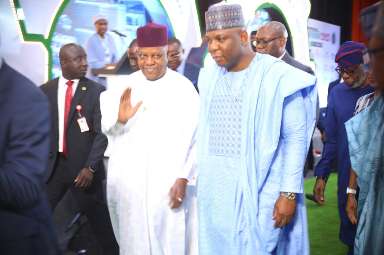
President Bola Ahmed Tinubu, represented by Vice President Kashim Shettima, led the high-powered attendance which included the Senate and House Committee Chairmen on Steel Development, Ministers of Finance, Solid Minerals, Transportation, Maritime & Blue Economy, Industry, Trade & Investment, and the Federal Capital Territory, alongside heads of agencies and private sector stakeholders.
He unveiled an ambitious plan to revive Nigeria’s steel sector, targeting the production of 10 million tonnes of liquid steel annually and the creation of over 500,000 jobs by 2030.
Tinubu said the administration was committed to resuscitating legacy steel assets, attracting private investment, and building a globally competitive industry.
The revival agenda extends beyond Ajaokuta Steel Company Limited, with ongoing efforts to rehabilitate both government-owned and privatized assets.
The President disclosed that Premium Steel & Mines Limited, formerly Delta Steel Company, had committed to restarting operations within 18 months, subject to raw material availability.
The investment drive has also attracted $400 million from Inner Galaxy Group to establish a new steel plant in Ewekoro, Ogun State, for the production of hot-rolled coils and plates—products currently fully imported into Nigeria.
The project, launched in April 2025, is expected to commence operations by April 2026, with government incentives to ensure timely completion.
To support domestic production, the government is rolling out a Scrap Aggregation Programme to regulate the collection and processing of scrap metal, reduce vandalism of public infrastructure, and create scrap collation centres in all six geopolitical zones, starting with the South-West.
On the legislative front, three key bills are progressing through the National Assembly, including the Metallurgical Industry Bill, the National Metallurgical Training Institute Establishment Bill, and an amendment to the National Steel Council Act.
The administration has mapped out a ten-year roadmap for sector-wide revival and a three-year plan specifically for operationalizing Ajaokuta Steel, covering infrastructure upgrades, regulatory reforms, and skills development.
“This is not merely an economic agenda—it is a national mission,” the Minister declared. “Government alone cannot revitalize the steel industry. We need private investors, our universities, skilled workers, and the patronage of Nigerians. Together, we can overcome decades of failure and achieve industrial greatness.”
The two-day summit will address critical issues including legacy project revival, logistics and energy access, investment incentives, raw material sourcing, quality assurance, and human capital development.
Tinubu urged stakeholders to contribute solutions that will position Nigeria as a hub for steel production in Africa.
“From the mines of Kogi to the factories of Aba, let us forge a nation as strong, resilient, and enduring as the steel we will produce.”
The Minister of Steel Development, Prince Shuaibu Abubakar Audu, in his opening remarks also unveiled a sweeping plan to revive Nigeria’s steel sector, targeting the production of 10 million tonnes of liquid steel annually by 2030 and the creation of over 500,000 jobs as a “national mission” for industrial transformation.
Prince Audu, said the agenda goes beyond the long-awaited completion of the Ajaokuta Steel Plant to include the rehabilitation of other legacy assets, both government-owned and privatized.
He underscored the strategic importance of the summit in aligning stakeholder efforts with the administration’s Renewed Hope Agenda, which targets a $1 trillion GDP by 2030.
“The steel sector is the backbone of industrial growth, vital to sectors like construction, manufacturing, energy, and defense. With our abundant raw materials, growing market, and government incentives, Nigeria has all it needs to become a major steel-producing nation,” the Minister said.
According to him, the summit will review the current state of the industry, identify policy and infrastructure gaps, explore investment opportunities, and craft actionable recommendations to ensure Nigeria becomes self-sufficient in steel production.
Stakeholders are expected to develop a coordinated plan to operationalize integrated steel plants, leverage the African Continental Free Trade Agreement, and boost local manufacturing, thereby reducing the country’s dependence on the over $4 billion annual steel import market.
The Minister emphasized that the sector’s revival would have a ripple effect on industrialization, job creation, infrastructure development, and national security, reinforcing its central role in achieving the administration’s eight-point priority agenda.
In his speech, the Chairman of the 10th Senate Committee on Steel Development, Senator Patrick Ndubueze, stressed that Nigeria must disrupt past approaches to managing Ajaokuta, which, he said, deprived the facility of vital revenue.
He recalled how previous wholesale concessions ended with the government paying $496 million to an Indian company without meaningful progress on steel production.
The lawmaker renewed his call for government-supervised scrap collection and recycling centers in each political zone to curb vandalism of public facilities for scrap sales.
Such measures, he argued, would not only grow the steel sector but also reduce criminal activities targeting industrial infrastructure.
In a passionate appeal, he lamented Ajaokuta’s crippling challenges, including debts of over ₦2 billion in electricity bills despite non-production, and a meagre share capital of ₦500,000 for an investment worth trillions.
He called for strict corporate governance, legislative reforms, and actionable commitments from the summit to position Nigeria as Africa’s hub for industrial excellence.
The Minister of Marine and Blue Economy, Adegboyega Oyetola, represented by Mrs. Amaka Okereke, emphasized the interconnection between steel production and marine infrastructure, from shipbuilding to port facilities.
He noted that a strong domestic steel industry could lower costs, accelerate project timelines, and strengthen Nigeria’s competitiveness in global trade.
Both the Senate and the executive arm pledged close collaboration with stakeholders to deliver a vibrant, sustainable, and competitive steel industry that reduces import dependence, creates jobs, and fuels economic transformation.
Over 300 delegates including ministers, state commissioners, industry leaders, and investors participated in the summit, engaging in keynote presentations, technical discussions, and networking sessions aimed at attracting new investments, fostering innovation, and creating partnerships.
The Summit continues tomorrow, with technical sessions focusing on financing models, public-private partnerships, and technology transfer for sustainable steel development in Nigeria.