By Joy Odor Abuja
The war drums against banditry in Nigeria’s North-West have been beaten louder and harder.
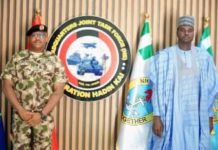
In a blistering new directive that signals a dangerous escalation in the fight for territorial control, the Theatre Commander of Joint Task Force Operation FANSAN YAMMA (North West), Major General W.B. Idris, has ordered frontline troops to “go after the bandits and stamp them out completely.”
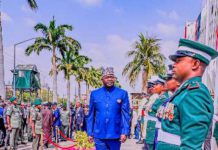
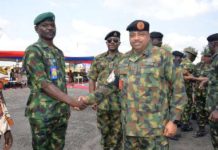
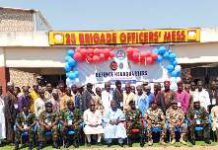
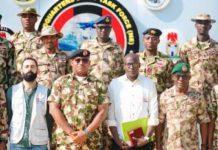
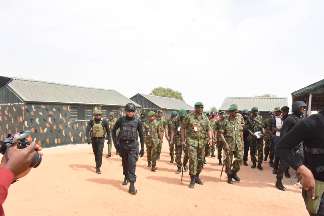
The order was issued Tuesday in Sokoto during General Idris’ maiden operational assessment visit to the Headquarters of the 8 Division, Nigerian Army, and Sector 2 of Operation FANSAN YAMMA at the Giginya Barracks, an appearance that visibly reset the tempo of the counter-bandit campaign.
Standing before battle-hardened troops, the Theatre Commander made it clear that the operation was entering what he described as a new, high-intensity phase one that would demand more sacrifice, fiercer resolve and absolute psychological readiness from soldiers already stretched by years of asymmetric warfare.
“This battle is only just beginning,” Idris told the troops. “Victory will come through courage, discipline, dedication and sacrifice.”
Unlike routine Command visits weighed down by protocol, Idris’ presence in Sokoto was driven by three blunt objectives: to measure battlefield performance, audit training readiness, and personally assess the welfare of troops wounded in action.
Behind closed doors, he reviewed operational strategies and logistics, while making it clear that the fight would not be slowed by equipment shortages.
He pledged advanced combat resources, sustained logistics and battlefield support to ensure troops maintain the upper hand in the brutal contest for North-West Nigeria.
- The Theatre Commander
- singl
- ed
- out the General Officer Commanding (GOC) 8 Division and Commander Sector 2 OPFY, Major General Ibikunle Ajose, for what he described as a proactive, intelligence-driven approach to dismantling criminal networks across the sector.
Ajose had earlier presented a detailed operational briefing, outlining recent battlefield gains, training intensity, and the persistent logistics pressures facing the troops.
The briefing underscored a campaign that has recorded progress but one still battling entrenched, highly mobile armed groups across difficult terrain.
In a moment that cut through military formality, Idris broke from the command floor to visit soldiers wounded in action.
He spoke with them individually, assuring them that their sacrifices would not be forgotten and that the Army was committed to their full medical recovery.
The emotional edge of the visit deepened when he later shared a meal with frontline troops of the 248 Battalion in Ilela, a border community that has witnessed repeated bandit incursions.
The message was unmistakable: the commander is not removed from the front, he is embedded in it.
The Sokoto visit sends a direct warning to armed groups terrorising communities across Zamfara, Sokoto, Katsina and parts of Kebbi: the posture of containment is shifting toward total eradication.
Security analysts say the language used by the Theatre Commander is among the strongest heard since Operation FANSAN YAMMA was activated suggesting a transition from defensive suppression to aggressive clearance operations across rural strongholds.
Banditry in the North-West has evolved into a complex terror economy involving arms trafficking, illegal mining, mass abductions and cross-border criminal movement.
Thousands have been killed, entire villages emptied, and agricultural production repeatedly disrupted deepening Nigeria’s food security crisis.
For the military, the North-West is no longer just a security theatre; it is a test of national stability.
As the inspection concluded with ceremonial honours, operational briefings and interactions across units one message echoed louder than all others:
This is no longer a holding operation. This is a hunt.
And for Nigeria’s bandit networks, the space to hide is rapidly collapsing.