By Joy Odor, Abuja
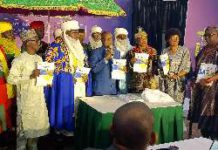
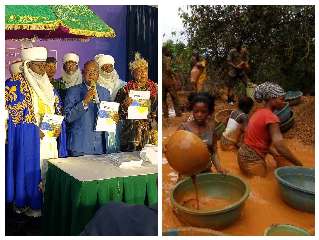
The chandeliers glittered above, but it was not the pump that filled the ballroom, it was urgent. Traditional rulers, such as HRH Eze Cosmas Agwu, Eze of Okposi, Ebonyi State, Oba Abdul Azeez Akinde Oloja Ekun of Igbesa, Aworiland, Alh. Khalid Usman
Sarkin Abuni, HRH Oba Omololu Afilaka Alatorin of Atorin Ijesa, HRH Dr. Zubairu Hamma Gabdo Emir of Gashaka, HRH Abdulakadir Ibrahim Bello II, Sarkin Katsinan Gusau – Emir of Gusau, HRH Kilang Mela Kojen Tangale Mai Kompta and Alh Muhammad Hassan Bahago
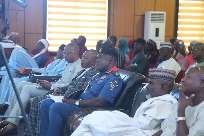
Yariman Minna, government officials, mining executives, and community voices from across West Africa gathered under one roof, their eyes fixed on a shared but contested future.
The occasion was the 5th West African Mining Host Communities Indaba with themed “The Intersection of Green Mining and the Right to Free, Prior and Informed Consent (FPIC) held in Abuja on Monday. More than a conference, it became a collision of truth, power, and possibility.
From the podium, the message rang out clearly: the future of global energy lies beneath Africa’s soil, but the survival of its people depends on how that wealth is harnessed.
Australia, a mining giant, was watching closely. Its High Commissioner declared, “The future is mining. But mining communities must be partners in progress.”
He spoke of a future where lithium, cobalt, and cleaner fuels power not just the world’s energy transition, but also justice, opportunity, and inclusion. Nigerian ministers, CEOs, and traditional leaders had already travelled to Australia, forging partnerships across continents. But as applause echoed, the reality on the ground struck like thunder from experience Sharing, Voices of Displaced Communities, Stories of Land Loss and Resistance in Nigeria, Mali, Sierra Leone, Ghana, Cote D’Ivoire among others flows, with Alh. Muhammad Hassan Bahago, Yariman Minna Emir of Niger State, told of villages overrun by illegal miners, farmlands stripped bare, rivers poisoned, and bandits enriched by the chaos.
“We are left with hunger, insecurity, and polluted water,” he said, his voice heavy with restrained anger.
From Oyo State, HRH Oba Omololu Afilaka-Alatorin of Atorin Ijesa shared how his people sit atop gold and lithium, resources that should be blessings. Instead, they brought terror.
“I was nearly abducted,” he revealed, describing a battle against illegal miners backed by powerful politicians.
His community had dared to dream big, building a legitimate mining company and attracting $100 million in investment. Now, greed, lawlessness, and violence threaten to crush that dream.
Then came a chilling account from Dr. Daniel Maddo, Maiganga Community, Nigeria: toxic runoff from coal mines had poisoned rivers, sickened children, and killed livestock. The community fought back in court and won a $100 million compensation order, only to face endless appeals from powerful companies.
“We fight with evidence,” a representative said bitterly, “but they fight with power.”
These testimonies echoed across borders—Ghana by Chibese Ezekiel, Strat, Sierra Leone by Deborah N’gozzi Lahai, Action for Women and Children’s Development and
Guinea by Lamarana Diallo, Action Mines, each voice carrying the same refrain: displacement, inequity, destroyed livelihoods.
Youth abandoned farms for cities. Women bore the brunt of poverty. Laws existed but were never enforced. Yet the Indaba was not a funeral. It was a declaration of survival.
Communities are beginning to form their own companies to claim control of their resources. Civil society groups are pushing for new mining laws. Courts, slow but stubborn, remain arenas of justice. Traditional rulers, elders, and youth stood shoulder to shoulder, their message unflinching:
“We are not victims. We are partners. We will not be erased from the story of Africa’s mineral future.”
As the world races toward clean energy, Africa’s minerals are no longer just commodities, they are the beating heart of the global transition. But the Indaba made one truth impossible to ignore: the energy transition will not be just if it leaves mining communities in ruins.
Africa’s minerals may power the world, but justice demands that the hands that mine them are not left empty, the lands that bear them are not stripped barren, and the voices that rise from them are not silenced.
As the session ended, a cultural troupe filled the room with drums. It was no mere performance, but a reminder: Africa’s heartbeat is strong, its people unyielding, its future alive with possibility.
The ground shook that day, not from the blasts of mining explosives, but from the voices of communities demanding their rightful place in history.