By Joy Odor | Reportcircle News
What began as a quiet thought during an ordinary morning walk has exploded into one of Nigeria’s most politically revealing books on democracy, danger and the hidden cost of election reporting.
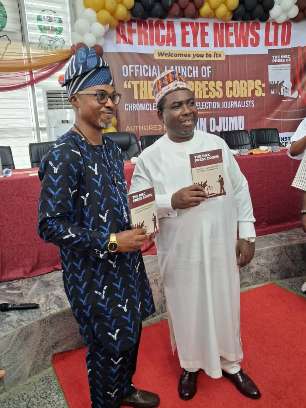
At the official unveiling of “The INEC Press Corps: Chronicles of Nigeria’s Election Journalists,” the author and Chairman of the INEC Press Corps, Segun Ojumu, stood before the nation’s electoral power brokers, media executives and political stakeholders to declare what many in the hall already knew:
Nigeria’s democracy has been written not only in ballots, but in blood, fear, resilience and ink.
“This is a deeply personal and profoundly moving day for me,” Ojumu said, fighting back emotion. “This book was born from a single thought during a morning walk. It has now grown into a national record of courage.”
December 2025, Ojumu revealed, marks 11 years since he first walked into INEC as a correspondent and 10 years since he covered his first major election cycle. In that decade, he said, both Nigeria’s electoral system and election journalism have been violently transformed.
“I have watched the electoral landscape and our profession change in ways none of us imagined,” he said. “This book is my offering to that history.”
The book, he explained, is not merely about elections, it is about the men and women who stand between rumour and reality, those who are often first on the battlefield and last to leave the political frontlines.
Ojumu told the audience that every page of the book carries not just information, but danger.
“When you open this book, you are not just reading about elections,” he said. “You are reading the history of courage.”
He drew attention to the documented ordeal of a colleague, Chux, whose election assignment nearly cost him his life. The reference triggered spontaneous applause in the hall.
“These stories show the high personal price journalists pay just to deliver the truth,” Ojumu said. “Often in hostile environments, far from safety, far from comfort.”
Beyond danger, the book also tracks the technological revolution reshaping Nigeria’s elections — from electronic accreditation to real-time result viewing.
Ojumu explained that these changes have forced journalists into a new battlefield.
“This is no longer just about chasing soundbites,” he warned. “Today’s election reporter must interpret data, interrogate digital systems and explain technology to the public in real time.”
He issued a strong challenge to the media industry:
“We must re-skill. We must up-skill. We must stay in the game.”
Ojumu also spotlighted a rarely discussed crisis in election reporting mental trauma.
“We need continuous specialised training, but also mental resilience support for journalists covering volatile political environments,” he said. “Our professionalism is our greatest asset, and it must be protected.”
In one of the most politically loaded moments of his address, Ojumu turned directly to political parties, security agencies and government institutions:
“Our democracy can only thrive when the messenger is protected,” he said. “Journalist safety is not optional. It is democratic infrastructure.”
He declared the book a declaration of principle:
“A truly independent and courageous press corps is indispensable to any democratic system.”
Ojumu revealed that the book carries two personal ambitions:
First, to inspire journalists to write their own stories and stop allowing Nigeria’s history to disappear into memory.
“Everybody here has a story,” he said. “The public deserves to hear them.”
Second, to force institutional collaboration around journalist safety during elections.
“There are countless untold experiences locked inside this press corps,” he said. “They must not die in silence.”
In an emotional closing, Ojumu publicly thanked:
The INEC Chairman
The Chairman of IPAC
The Director-General of the Electoral Institute
Past and serving Chief Press Secretaries
And members of the press corps
But the deepest moment came when he turned to acknowledge his mother, whom he called the force that taught him discipline and focus, and his wife, who, he said, “stood behind the dream when it looked impossible.”
What makes “Chronicles of Nigeria’s Election Journalists” politically explosive is not just what it contains but what it exposes:
The physical danger behind election coverage
The psychological toll of political reporting
The digital disruption of Nigeria’s voting system
The fragile bridge between power and public trust
It is a book that pulls Nigerian democracy out of political abstraction and drops it into real danger, real fear, real sacrifice.
And as Segun Ojumu made clear at the launch, this is not the end of the story.
“This book is not just a record,” he said. “It is a challenge. To the press. To politicians. To the nation.”