By Joy Odor – Reportcircle News
For years, Nigeria’s pension crisis thrived in the shadows fueled by silence, misinformation and a media gap that allowed suffering to go unseen and unchallenged.
But at a high-level training workshop for the Association of Corporate Online Editors (ACOE) and pension correspondents, that silence was formally declared the new frontline of battle.
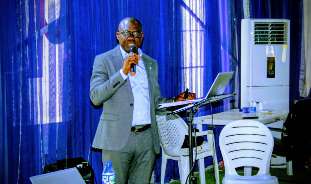
In a blunt and emotionally charged presentation, the Head of Corporate Communication of the Pension Transitional Arrangement Directorate (PTAD), Olugbenga Ajayi, placed the media at the heart of Nigeria’s pension reform war, describing journalists not as observers, but as decisive actors in the fight to rescue millions of vulnerable retirees from institutional failure.
Speaking on Collaboration with PTAD Communication Channels, Information Requests, and Fact-Checking Pensioners’ Claims to Avoid Disinformation, Ajayi delivered a powerful message: without the media, pension reform will fail no matter how advanced the technology becomes.
Ajayi traced Nigeria’s pension catastrophe to more than just corruption and bureaucracy.
He fingered misinformation, rumor networks and digital illiteracy as silent killers that deepened the trauma of retirees.
“For years, pensioners didn’t only suffer from unpaid entitlements,” he said. “They suffered from false hope, wrong information and panic induced by unverified reports.”
In the vacuum of credible communication, fake payment alerts spread faster than official notices.
Protest rumors triggered chaos. Pensioners traveled across states based on false claims, only to return empty-handed.
“In today’s Nigeria,” Ajayi warned, “falsehood travels faster than the truth if the media is not vigilant.”
Ajayi reminded the audience that before PTAD’s intervention, pension administration was an analogue jungle, paper files stacked in dusty rooms, records missing, identities unverifiable and payments delayed endlessly.
Pensioners queued under the sun for repeated physical verification. Many collapsed. Some died. Yet, he noted, much of that suffering remained invisible for years because it was poorly documented and weakly interrogated in the public space.
Now, PTAD is flipping that narrative through digital transformation moving pension records into secure platforms where verification can happen remotely and entitlements tracked in real time.
But Ajayi made it clear: technology without media visibility is powerless.
“A database cannot speak for itself,” he said. “The media gives reforms a voice. Without you, the public will never understand what has changed.”
In one of the most striking moments of the session, Ajayi directly reframed the role of editors and reporters as defenders of national pension stability.
“You are no longer just reporting pensions,” he told them. “You are protecting pensioners from disinformation, fraud and digital sabotage.”
He disclosed that fake claims, doctored screenshots, and manipulated payment narratives regularly flood social media creating public distrust even when genuine progress is being made.
That is why, he said, PTAD is now formalising collaboration with media organisations for structured information requests, real-time clarification and professional fact-checking before publication.
The goal: kill false narratives before they kill public confidence.
Ajayi urged the media not to reduce pension reporting to policy grammar and payment statistics alone. Each pension story, he said, is a survival story.
“These are not abstract numbers,” he told the room. “These are teachers who taught without pay for months, soldiers who fought without insurance, civil servants who built institutions that today barely remember them.”
Many retirees, he noted, are digitally excluded, medically fragile and financially stranded, making false reports not just misleading, but dangerous.
“A wrong headline can send a sick pensioner on a wasted journey. And that journey can be fatal,” he said quietly.
Despite growing digital capacity, Ajayi admitted that PTAD still operates under manpower pressure while managing one of the most sensitive social obligations in the country.
“We are not many,” he said. “But the burden is national.”
Without responsible media partnership, he warned, even the strongest digital reforms can collapse under the weight of public distrust.
What is unfolding, Ajayi stressed, is no longer just a technical cleanup of pension databases, it is a struggle over narrative power.
“This is a fight between the old system of chaos and a new system of accountability,” he said. “And the media decides which one Nigerians will believe.”
From dusty filing cabinets to digital dashboards, from secrecy to scrutiny, Nigeria’s pension system is now under permanent public watch and for the first time in decades, that spotlight is being formally handed to the media.
For journalists in the room, the message was unmistakable: This is no longer just another government beat. This is a national accountability assignment.
And in this war between disinformation and digital reform, the newsroom not the payment office may now be the most powerful weapon of all.