By Joy Odor
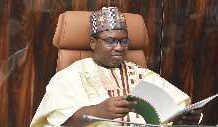
The Independent National Electoral Commission (INEC), Chairman, Prof. Mahmood Yakubu has informed that the Commission has fully implemented all 13 recommendations directed to it by the ECOWAS Election Observation Mission (EOM) following Nigeria’s 2023 General Elections.
Prof. Yakubu made the disclosure during a high-level meeting with a visiting delegation from the ECOWAS Network of Electoral Commissions (ECONEC), on Monday in Abuja which is currently in Nigeria on a post-election follow-up and needs assessment mission.
The ECONEC team is evaluating the progress made on a broader set of 37 reform recommendations issued after the polls.
The delegation is led by Mrs. Davidetta Browne-Lansanah, Chairperson of Liberia’s National Elections Commission, includes senior officials from Ghana’s Electoral Commission, the ECOWAS Electoral Assistance Division, and technical partners from GIZ, EISA, and International IDEA.
Speaking at the meeting, Prof. Yakubu affirmed INEC’s commitment to electoral improvement, noting that the Commission had acted swiftly on all recommendations within its administrative capacity.
“Of the 13 recommendations addressed to INEC, we have fully implemented those requiring administrative action,” he stated. “Others that involve legal reforms are awaiting action by the National Assembly.”
He added that INEC’s internal reform drive incorporates the ECOWAS proposals into a broader post-election review process, culminating in a 142-point reform document developed through nationwide consultations.
This document, along with other key reports, is available on the Commission’s website and was shared with the ECONEC team.
While Prof. Yakubu did not list each of the 13 recommendations, he noted they spanned vital operational areas such as election logistics, result transmission systems, training of personnel, voter education, ICT infrastructure resilience, inclusion of marginalized groups, and inter-agency coordination on election security.
He also reiterated that ECOWAS made a total of 37 recommendations—13 directed to INEC and 24 to other institutions including the National Assembly, the Nigeria Police Force, National Identity Management Commission (NIMC), National Broadcasting Commission (NBC), political parties, and civil society organisations.
Prof. Yakubu welcomed the ECONEC mission as an opportunity for mutual learning and accountability, emphasizing the importance of post-election peer engagements in strengthening democratic institutions across West Africa.
“Observation missions are not just about writing reports; the real value lies in follow-up and continued engagement,” he said. “We appreciate this visit as a demonstration of solidarity and commitment to improving electoral processes across the region.”
He also commended Nigeria’s development partners, especially GIZ, EISA, and International IDEA, for their technical and financial support in driving electoral reforms.
Responding on behalf of the ECONEC Mission, Mrs. Browne-Lansanah praised INEC’s transparency and cooperation, describing the visit as a peer-review exercise aimed at drawing regional lessons from Nigeria’s electoral experience.
“We came to see how INEC has responded to our recommendations. The challenges Nigeria faced are similar to those faced across the sub-region, and we hope to learn from your solutions,” she said.
She expressed deep gratitude to Nigeria for its leadership and solidarity in supporting other West African electoral commissions, especially Liberia, citing INEC’s critical support in equipping her country’s electoral ICT infrastructure.
“Through ECONEC and Nigeria’s leadership, we were able to establish an ICT centre in Liberia. Your support changed the trajectory of our election management,” she said emotionally.
Mrs. Browne-Lansanah reaffirmed ECONEC’s commitment to promoting collaborative learning, stating that lessons from Nigeria’s 2023 elections would help inform electoral improvements across the sub-region.
“We are here to learn, share, and replicate best practices. Strengthening electoral bodies is key to sustaining democracy in West Africa,” she concluded.