By Joy Odor – Reportcircle News
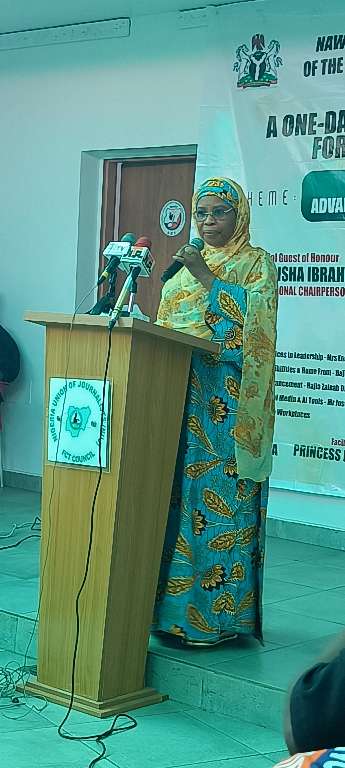
In a hall filled with journalists, policymakers, and media executives, the atmosphere shifted the moment Hajiya Halima Musa, Director of News at the Nigerian Television Authority (NTA), took the podium.
She wasn’t there to recite theories, She wasn’t there to flatter the system, She came with something more disruptive “truth”.
Delivering a paper titled “Balancing Work Responsibilities and the Home Front” at a One Day Capacity Building Training for 100 Female Journalists with the Theme Workplace Diversification: Advancing Female Journalists ‘ Role in the Newsroom”, Hajiya Halima framed her message around a political and professional reality the industry often avoids: the newsroom is not just a workplace, it is a battlefield where women must negotiate identity, survival, and legitimacy.
Hajiya Halima described journalism as one of Nigeria’s most politically sensitive and professionally punishing jobs, one that summons practitioners morning, afternoon and night.
She likened it to the emergency reflexes of a doctor and the stamina of a firefighter. But she stressed a point that resonated politically and socially: for women, the burden is structurally heavier.
While the media is often a watchdog for government and society, it rarely acknowledges its own internal imbalances.
Women chase breaking news with the same intensity as their male colleagues. They cover conflict, emergencies, and high-risk assignments. Many go home bruised, emotionally and physically yet are still expected to be fully present mothers, wives, and caregivers.
Hajiya Halima didn’t mince words:
Achieving work–life balance in journalism is not merely a “challenge” it is a crisis shaped by political, cultural, and institutional forces.
Women lose opportunities not because they lack competence, but because the social system makes them default managers of domestic emergencies:
a sick child
a failing marriage
a household crisis
societal expectations that place caregiving squarely on their shoulders
Meanwhile, the profession itself operates on a system built around menlong hours, unpredictable shifts, late-night beats, and newsroom politics shaped in male-dominated informal spaces.
Women are expected to deliver the same output without the same freedom.
She addressed an uncomfortable political reality: Female journalists are still stereotyped, sexualized, and sidelined.
Some are branded “easy.”
Others are dismissed as fit only for “soft beats” women affairs, children, lifestyle.
Assignments that shape public policy or political discourse security, governance, investigations are still routinely handed to men.
Meanwhile, men bond over drinks in press centres and smoky clubs spaces where decisions about assignments, access, and advancement are quietly made.
Women who don’t join are labelled “arrogant.” Those who do are judged harshly.
This, she argued, is not merely cultural, it is structural discrimination that shapes political representation in newsrooms.
Beyond stereotypes, she cited real cases of harassment, exclusion, and silent punishment of women who dare to assert boundaries.
Female journalists, she noted, walk a political tightrope:
If they prioritise family, they are seen as unserious.
If they prioritise work, they are accused of neglect.
If they try to do both, they are told they are “overwhelmed.”
This invisible wall keeps many women away from leadership roles despite merit and years of service.
Her tone softened as she addressed another truth:
Marriage can either be a fortress or a trap for career women.
She urged young journalists to choose partners carefully, warning that the wrong spouse can sabotage a career faster than any newsroom politics.
She told the story of a journalist whose husband took a second wife because she was “never home” only for the new wife to refuse caring for the children.
The conflict destabilized the home and nearly ended the journalist’s career.
In a society where marriage is political capital, she argued, supportive spouses are not optional, they are essential.
She urged women to uphold professionalism:
stay above gossip groups
arrive early
carry themselves with dignity
protect their moral and professional reputation
For many women, she emphasised, their public conduct is scrutinised more harshly than men’s. One slip becomes a political weapon used against them.
Prayer and emotional resilience, she said, remain anchors for many navigating the chaos of the newsroom.
Hajiya Halima called for a political coalition among women in the media.
Senior women, she noted, must mentor younger reporters, offering emotional and professional support in an industry that often breaks spirits.
She spoke of young reporters who have cried in her office, over failed marriages, hostile editors, impossible assignments, and how sisterhood helped them endure.
“Cry if you must,” she told them.
“Cry and rise.”
Despite exposing the system’s failings, Hajiya Halima ended on a balanced, hopeful note.
Journalism, she said, remains a powerful and transformative career.
It opens doors to policymakers, global institutions, and decision-making spaces.
It sharpens intellect, builds networks, and empowers women to influence public discourse.
Given supportive structures professional, political, and familial women in journalism cannot only thrive but excel.
Her closing message hit with clarity:
“Female journalists do more than report the news. They survive it. They shape it. They pay a price for it.”
And with a steady voice, she reminded the room:
“Journalism is an exceptional career, and women, given the chance, will continue to prove it.”
A statement not just of hope, but of political intent, one that challenges the media industry to evolve, reform, and finally acknowledge the women who keep its engines running.