By Reportcircle Abuja
Nigeria’s capital, Abuja, became the front line of a new kind of national security challenge on Monday as diplomats, media leaders, and foreign mission officials converged for a one-day high-level workshop aimed at confronting one of the country’s fastest-growing threats Foreign Information Manipulation and Interference (FIMI).
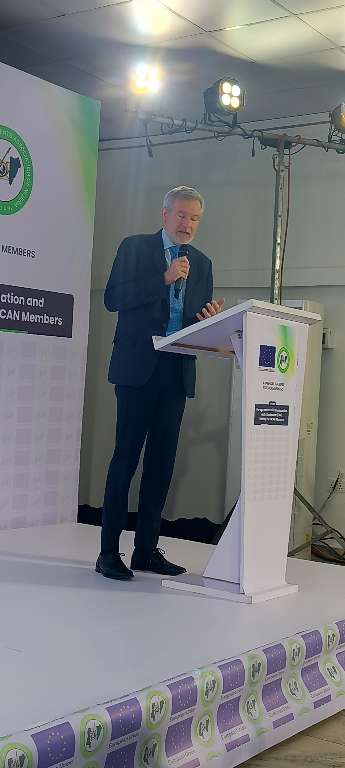
Hosted for members of the Diplomatic Correspondents Association of Nigeria (DICAN), the session opened with a stark warning by the European Union Ambassador to Nigeria and ECOWAS, H. E. Gautier Mignot: Nigeria is drowning in disinformation and the consequences for national stability, democracy, and public trust are increasingly catastrophic.
From political propaganda to digitally-engineered forgeries, Gautier described a rapidly evolving information war where falsehoods travel faster than fact, weaponiszed narratives fracture communities, and foreign actors exploit societal vulnerabilities to undermine democratic institutions.
Setting the tone, the keynote address by EU Ambassador stressed that misinformation and disinformation are no longer harmless online noise but clear instruments of social destabilisation.
“False information compromises the integrity of the media, undermines trust in public institutions, and weakens people’s capacity to take informed decisions,” the speaker warned. “Once people lose faith in the media, a pillar of democracy, the entire system is endangered.”
The message was unambiguous: the credibility of journalists and diplomats alike depends on the truthfulness of the information they disseminate.
Gautier reminded Participants that the media, as chief gatekeepers of public information, have become prime targets of manipulation.
“Journalists are multipliers in the information value-chain,” the address continued. “Once the media is misinformed, the entire society becomes vulnerable.”
With deepfake videos, AI-generated images, fabricated documents, and hyper-targeted social media content now used to deceive the public at scale, the workshop highlighted how the line between reality and forgery grows thinner by the day.
International statistics presented at the event underscored the global nature of the crisis:
85% of people worldwide fear the impact of disinformation on society
87% believe disinformation has already influenced their country’s political life
38% of EU citizens now view misleading information as a threat to democracy
Nigeria mirrors this trajectory. A CDD report cited during the workshop described the country’s disinformation space as “unprecedented” turbocharged by ethnic, political, and religious rifts and amplified by a hyperactive rumour mill.
In a surprising twist, EU Ambassador noted that the chaos of unregulated digital platforms may be pushing Nigerians back to traditional media but only if the media can uphold reliability.
Two conditions were laid out:
1. Media must prioritise truth over speed.
2. Citizens must reject comforting falsehoods in favour of inconvenient facts.
Without this, Gautier warned, professional journalism risks becoming indistinguishable from online noise.
The workshop did not shy away from sensitive geopolitical concerns. Foreign manipulation campaigns especially those portraying military takeovers in parts of West Africa as “heroic alternatives” to democratic governance were cited as serious dangers seeping into Nigeria’s information ecosystem.
“These narratives glamorise anti-democratic actors while undermining the values that hold our society together,” participants were told.
The EU Ambassador outlined a suite of initiatives in Nigeria to strengthen the country’s resilience against FIMI. These include:
Monitoring disinformation targeting elections
Promoting media literacy nationwide
Funding fact-checking platforms and research
Training Nigerian editors and journalists (including in Europe and conflict zones like Ukraine)
Supporting media freedom and pluralism
Collaborating with civil society and tech platforms to counter manipulative content
The EU has partnered with organisations like Dubawa and engaged the Nigerian Guild of Editors in fact-checking programmes earlier this year.
Participants were told they were chosen for four strategic reasons:
1. They sit at the frontline of public information flow.
2. They interface daily between Nigeria and the global community.
3. They cover EU institutions more than any other media group.
4. They previously demonstrated commitment to combating FIMI.
“This workshop is a direct response to your request for capacity-building,” officials said.
The workshop ended with an urgent appeal: Nigeria’s battle against foreign manipulation will not be won by institutions alone.
It requires a media sector that is vigilant, well-trained, and ethically grounded and a public capable of recognising truth from weaponized fiction.
“If our society is to thrive, citizens must be literate enough to identify trusted sources and reject manipulative narratives,” the speaker concluded.
“Your participation today is not just training, it is a defence of democracy itself.”