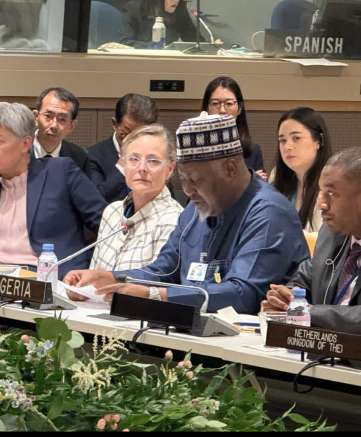
By Reportcircle-Abuja
Nigeria has sounded a powerful alarm at the United Nations, urging world leaders to immediately begin negotiations on a treaty banning the production of fissile material, the key ingredient in nuclear weapons.
At the first Ministerial Meeting of the “Friends of an FMCT” convened by Japan on the sidelines of the 80th UN General Assembly, Nigeria’s Minister of Defence, Mohammed Abubakar Badaru in his address declared that the world faces a moral and legal imperative to close the fissile material gap before it ignites a fresh global arms race.
“Closing the fissile material gap is the most realistic way to stop an uncontrolled arms race,” Badaru warned. “The FMCT will rebuild trust, strengthen the Non-Proliferation Treaty and give momentum back to disarmament.”
With the 80th anniversaries of Hiroshima and Nagasaki casting a long shadow over the discussions, the Minister said the tragedies demand bold action.
“The memory of Hiroshima and Nagasaki compels us to act with courage. The survival of humanity demands it,” he declared.
Nigeria used the platform to spotlight Africa’s track record of restraint, citing the Treaty of Pelindaba, which created a nuclear-weapon-free zone across the continent.
“Africa has shown that restraint is possible. Nigeria now calls for that same spirit to guide global action,” Badaru added.
Nigeria’s Three-Point Action Plan
To kickstart progress toward a Fissile Material Cut-off Treaty (FMCT), Badaru proposed:
A global moratorium on the production of fissile material for weapons use.
Dismantling or converting existing facilities to peaceful purposes.
Leveraging these interim steps to build political momentum for a universal, verifiable, and non-discriminatory treaty.
Linking nuclear disarmament to President Bola Ahmed Tinubu’s Renewed Hope Agenda, the Minister stressed that global security and national development are inseparable:
“Disarmament is not an abstract debate. Every step we take to reduce nuclear risks frees resources for health, education, and economic growth.”
Nigeria’s intervention marks a strategic shift from participant to leader in global disarmament diplomacy, positioning itself as a bridge-builder capable of aligning Africa’s achievements with international policy.
As world leaders grapple with rising geopolitical tensions and renewed nuclear posturing, Nigeria’s message was clear: the time for rhetoric is over, the time for action is now.