By Joy Odor, Abuja
Nigeria’s top diplomats and foreign policy experts have delivered a stark warning: unless the country urgently embraces anticipatory, cyber, and digital diplomacy, it risks losing sovereignty, security, and global relevance in the digital age.
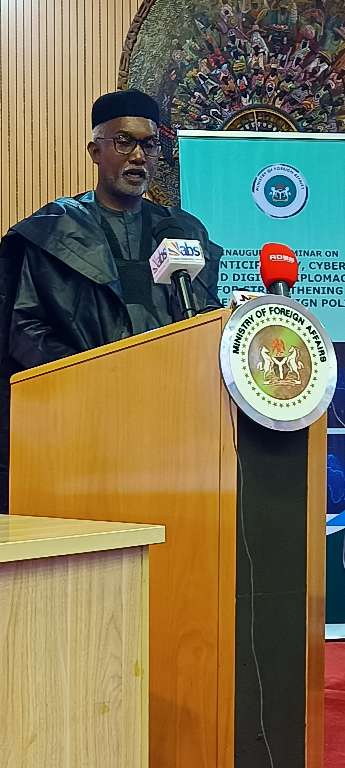
At the High-Level Seminar on Anticipatory, Cyber and Digital Diplomacy held Tuesday in Abuja, Minister of Foreign Affairs, Ambassador Yusuf Maitama Tuggar, Attorney General of the Federation (AGF), Prince Lateef Olasunkanmi Fagbemi, SAN and International Relations Expert, Dr. Nnenna Ifeanyi-Ajufo stressed that Nigeria must lead not follow in shaping the global digital order.
Ambassador Tuggar declared that disruptive technologies, shifting geopolitics, and the militarisation of cyberspace are “fundamentally rewriting diplomacy.”
Nigeria, he warned, cannot afford to watch from the sidelines.
“We must act with purpose to position ourselves as a principled, capable, and forward-looking actor in the evolving global digital order,” he said.
The Minister announced the creation of a Cyber Diplomacy Unit within the Ministry of Foreign Affairs to coordinate Nigeria’s cyber-related foreign policy and ensure Nigeria’s voice is influential in international cyberspace governance.
He also launched a Masterclass Series on Cyber and Digital Diplomacy to train diplomats across Africa and the Global South, describing it as Nigeria’s “digital gift to the world.”
Tuggar cited crypto-driven crimes, online disinformation, and gaps in digital regulation as threats already destabilizing Nigeria.
“The purpose of cyber diplomacy is to help systems catch up, to promote the best technology can do for growth, stability, and freedom,” he stressed.
Speaking, the AGF, Prince Lateef Olasunkanmi Fagbemi, SAN echoed the urgency, saying traditional diplomacy is inadequate for the 21st century.
“The rise of a globally interconnected digital landscape presents both unprecedented opportunities and complex challenges, rendering traditional diplomatic methods insufficient,” he said.
He described anticipatory diplomacy as a proactive approach to detect threats before they escalate, adding that Nigeria must adopt new legal frameworks to regulate artificial intelligence, cybersecurity, and ethical technology use.
“Cyber threats endanger both national infrastructure and the rule of law. We must build frameworks strong enough to deter crime, enforce justice, and foster international cooperation,” he warned.
Also, Dr. Nnenna
Ifeanyi-Ajufo sharpened the message, insisting that power and sovereignty are being redefined in data centers, digital platforms, and AI, not on traditional battlefields.
“We are living in an era where influence is being forged in cyberspace. Nations that will thrive in the 21st century are those that adapt swiftly, think ahead, and engage globally. Nigeria must not be left behind,” she said.
Nnenna urged Nigeria to adopt a whole-of-nation approach, government, private sector, academia, and civil society to build resilience through anticipatory, cyber, and digital diplomacy.
Her six-point action plan for the Ministry of Foreign Affairs included:
Creating a Directorate of Future Diplomacy,
Developing a national cyber strategy,
Building regional and global partnerships,
Establishing a Foreign Policy AI Lab,
Training diplomats in AI ethics and digital literacy, and
Reforming diplomatic curricula to embed foresight and technology policy.
“Tomorrow belongs to those who prepare for it today,” she concluded.
“The future is being written now in algorithms, cyber norms, and digital platforms. Our influence depends on our innovation. Our resilience depends on our readiness. Nigeria must answer the call.”
The seminar, attended by National Security Adviser Mallam Nuhu Ribadu, British High Commissioner Richard Montgomery, African Union cybersecurity experts, and diplomats, underscored that technology, diplomacy, and national security are now inseparable.
The consensus: Nigeria’s survival and leadership in the 21st century will be determined not by oil or armies, but by its ability to anticipate, secure, and dominate the digital frontier.