By Reportcircle Abuja
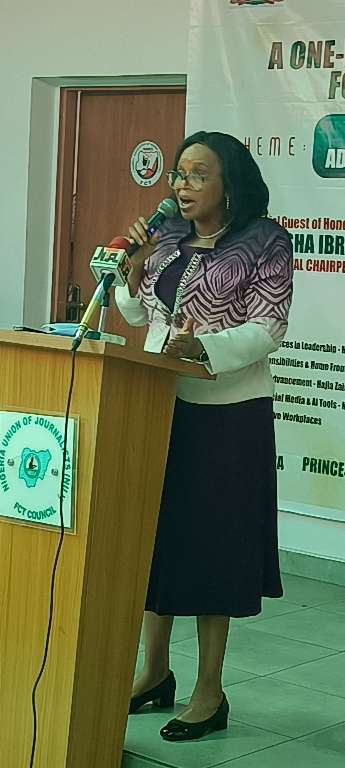
It was not just another Tuesday in the Federal Capital Territory. The air inside the training hall crackled with purpose as female journalists from across Abuja gathered for a one-day capacity-building programme.
But it was the voice that took the podium steady, seasoned, and unapologetically bold that transformed the room into a rallying ground.
Mrs. Eno Olotu, Director of Press and Public Relations, of the Head of the Civil Service of of the Federation in a paper presentations on Amplifying Women’s Voice in Leadership delivered what quickly became a hard-hitting call to action: women’s voices in leadership are not just under-amplified, they are systemically muted and the media must change that.
“Good morning distinguished ladies and gentlemen” she began but the politeness ended there.
Olotu wasted no time pulling the veil off a national contradiction: Nigeria’s women make up nearly half of the population, yet occupy less than 10% of political and high-level decision-making positions.
Not because they lack competence or ambition, but because their stories rarely make it into public consciousness.
“Journalists hold the pen that shapes perception,” she declared. “And women know, often too well, what it means to fight to be seen and heard.”
The journalists nodded, many with the weary affirmation of lived experience.
Across the world, women are leading governments, driving innovation, steering businesses, and transforming communities.
Yet their success stories, Olotu noted, often go untold or worse, are told through biased, patriarchal lenses that diminish rather than dignify.
“This is where the media comes in,” she said. “The stories we tell determine who is remembered, who is respected, and who is recognized as capable of leading.”
And for female journalists, she added, the assignment is not activism. It is accuracy, fairness, and the pursuit of truth.
Olotu’s voice sharpened as she dissected the media’s gatekeeping power.
“The media does not just report events,” she said. “It tells society what to think about and what is possible.”
If the press consistently puts women’s leadership on the front page, she argued, the normalization begins.
The next generation of girls grows up knowing that leadership isn’t a gendered privilege, it’s a human one.
Then came the toughest charge of the day, a playbook for every woman in a newsroom:
1. Narrative Shapers
Tell stories that spotlight competence, innovation, and impact not fashion, not family life, not stereotypes.
2. Agenda Setters
Decide that women’s successes deserve prime time, not the lifestyle page.
3. Mentors & Role Models
Every female news anchor, reporter, and editor becomes a mirror in which a young girl sees her future.
4. Advocates for Gender Equity
Push for gender-sensitive reporting and challenge newsroom biases.
5. Collaborators in Change
Build networks with women leaders, NGOs, and fellow journalists to keep women’s visibility alive and rising.
Her recommendations landed like a newsroom blueprint:
Give women equal airtime and expert commentary slots.
Launch dedicated programmes and columns on women in leadership.
Use data to reveal gender gaps and progress.
Leverage social media to spotlight emerging women leaders.
Train and uplift young female journalists to sustain the cycle of empowerment.
Olotu did not sugarcoat the reality inside many media houses.
Discrimination.
Harassment.
Glass ceilings.
Male-dominated management tables.
But she countered every challenge with a reminder of impact.
“Every story we tell about women breaking limits takes us one step closer to equality,” she said.
“Change begins with one bold story, one courageous voice, one determined journalist.”
As her speech drew to a close, the hall had fallen into an intense reflective silence.
“Amplifying the voices of women in leadership is not just advocacy,” she said firmly. “It is nation-building.”
Female journalists, she said, are not merely reporters, they are architects of perception, custodians of public memory, and the amplifiers of national progress.
And then came the line that exploded through the room and lingered long after the applause:
“When you empower a woman, you empower a family. When you give her a voice, you empower a generation. But when you give her a platform, you change a nation.”
Olotu urged the women to return to their newsrooms, studios, and camera desks with renewed purpose.
“Shine the spotlight on women breaking barriers,” she said. “Tell their stories with courage, compassion, and conviction.
Make their voices unforgettable.”
Because every headline, every interview, every published image has the power to ignite another woman’s rise.
The future of women’s leadership in Nigeria may well depend on the women who tell the story.