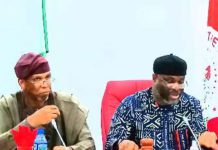
…Says defection to APC driven by need to protect constituents’ interests
By Joy Odor Politics & Governance Desk
Nigeria’s opposition Peoples Democratic Party (PDP) has suffered yet another high-profile defection, as Senator Jarigbe Agom-Jarigbe, representing Cross River North Senatorial District, on Tuesday formally resigned from the party, citing what he described as “deep-seated divisions and deliberate factionalisation” at both the national and state levels.
His resignation letter, read on the Senate floor by Deputy Senate President Jibrin Barau, marks the latest blow to a party already struggling to contain internal fractures, leadership tussles, and a wave of defections across the country.
In his statement to the Senate, Jarigbe said his decision followed “deep and thoughtful reflection on the current state of my former party.”
“It is with regret that I note the persistent and deep-seated divisions and the deliberate factionalization at both the national and state levels as the primary reasons for my departure,” he wrote.
Party insiders say Jarigbe’s exit had been long in the making, with months of strained relations between his camp and the PDP’s Cross River State leadership following disputes over control of party structures and nominations.
Declaring his new political allegiance, the senator said his decision to join the ruling All Progressives Congress (APC) was guided by his commitment to continue delivering “effective and responsible representation” to the people of Cross River North.
“In the light of the foregoing, and in the best interest of my constituents, I have chosen to join the All Progressives Congress,” he told the chamber.
The move effectively consolidates APC’s dominance in Cross River State, where Governor Bassey Otu and the majority of state legislators had already defected from the PDP, leaving the once-powerful opposition party in steady decline.
Jarigbe’s exit underscores what analysts describe as a deepening leadership vacuum within the PDP, still reeling from the fallout of the 2023 general elections and its unresolved internal disputes.
The party has faced defections in multiple states including Rivers, Edo, and Plateau, while ongoing litigation and rival factions have weakened its ability to mount an effective opposition.
“PDP’s fragmentation is no longer just a political problem, it’s an institutional collapse of cohesion,” said a political analyst who spoke to Reportcircle. “When Senators and Governors abandon ship one after another, it tells you the party has lost its anchor.”
With Jarigbe’s defection, the ruling APC further strengthens its numbers in the Senate, tightening its grip on key committees and legislative votes.
Observers say the defection may also alter Cross River’s political calculus ahead of the 2027 elections, as the APC consolidates its hold in a state that was once a PDP fortress.
For the PDP, Jarigbe’s departure is another sign that its long-promised reconciliation drive has yet to take root.
His blunt exit message that the PDP is fractured beyond repair echoes the sentiment of many within the opposition who fear the party may be heading toward political irrelevance unless drastic reforms are undertaken.
Bottom line:
Jarigbe’s defection is not just about one Senator switching sides. It is another headline in the slow-motion implosion of Nigeria’s main opposition and a reminder that in the country’s fluid political landscape, loyalty lasts only as long as a party can still deliver power.