By Joy Odor, Abuja
It began like a routine training session. But within minutes, the atmosphere in the room shifted first to surprise, then to disbelief, and finally to an uneasy silence.
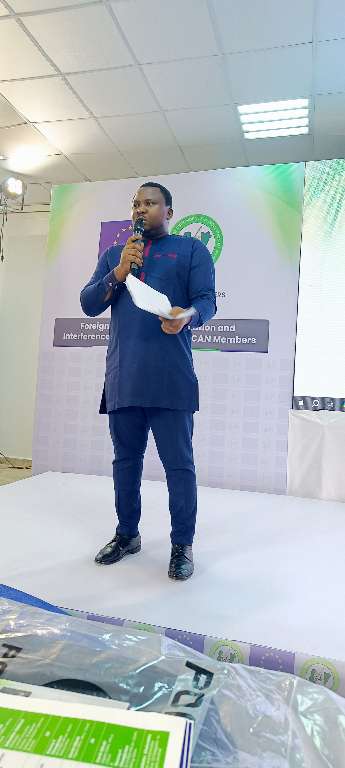
Standing before members of the Diplomatic Correspondents Association of Nigeria (DICAN)at a one day Training with the Theme Foreign Information Manipulation and Interference (FIMI), Mr. Ekeoma Precious Ohaegbulam, 2019/2020 Africa Liberty Writing Fellow, dismantled the comforting myths journalists tell themselves about their profession and replaced them with a brutal truth:
“If you don’t know why you should care, you have already lost the fight.”
His voice cut through the room like a warning siren. This wasn’t a lecture. It was an intervention.
From the onset, he challenged the audience to rethink their professional identity entirely.
“You are not just diplomatic correspondents. You are geopolitical observers,” he declared, pacing slowly as if searching for eyes willing to confront reality.
Journalists, he stressed, no longer merely report the news. They stand at the frontline of a global information battlefield where hostile actors exploit poverty, ethnic anxieties, and political frustration to destabilize Nigeria from within.
And the media often unknowingly is being used as the delivery mechanism.
Ohaegbulam warned that Nigeria’s vulnerability is worsened by the blind adoption of foreign communication concepts that have not been adapted for local realities.
He cited the principle of policy diffusion, the catastrophic failure that occurs when successful foreign ideas collapse in new environments.
“You cannot fight a global threat with foreign tools that have not been localized,” he insisted.
Nigeria’s media landscape, he argued, is uniquely volatile, with amplified fault lines that foreign disinformation networks eagerly exploit.
Using a timeline that stretched from Donald Trump’s “fake news” narrative to his administration’s flirtation with “alternative facts,” Ohaegbulam demonstrated how societies slide into epistemic anarchy.
“Truth now has versions,” he warned. “How many versions can a society survive before it collapses?”
The metaphor he chose was disarmingly simple:
“It’s like a pothole. Ignore it long enough, and one day it becomes too wide for any car to escape.”
Turning to global counter-disinformation frameworks, he applauded the European Union’s approach, one he urged Nigerian journalists to internalize like survival codes:
1. Manipulative
2. Intentional
3. Coordinated
These three indicators, he said, help distinguish a simple mistake from a deliberate attack.
“If you do not understand how your enemy works, you cannot fight back,” he warned.
To expose how destructive disinformation can be, he offered a chilling example:
“The President is dead.”
A fabricated story designed for chaos not clicks.
He contrasted it with propaganda, which simply glorifies power:
“Our government is the best in history!”
One is a bullet. The other is a banner. Only one destabilizes the nation.
Ohaegbulam then turned to the country’s internal fractures:
North–South rivalry
Religious suspicion
Ethnic mistrust
Inflation-driven anger
Fuel price resentment
Fear
Frustration
“Foreign actors rarely introduce new problems,” he said. “They weaponize the ones you already have.”
These “pain points,” he explained, are the raw ingredients for foreign information manipulation.
He carefully mapped out the life cycle of a foreign influence operation:
1. Identify a vulnerability
2. Plant a narrative in hidden channels
3. Amplify through paid influencers, bots and micro-accounts
4. Wait for Nigerian journalists to publish it for free
Then came the punchline that hung in the air like smoke:
“The foreign actor pays the micro-influencer. The micro-influencer trends the story. You the journalist amplify it.
They win. You worked. And you did not get paid.”
A murmur ran through the hall.
To show the longevity of information warfare, he revisited the troubling 1980s episode where the Soviet Union planted a false story in an Indian newspaper claiming HIV/AIDS was a U.S. bioweapon.
The world believed it.
The media amplified it.
The lie lived for decades.
“Technology has changed. The method has not,” he said.
He warned journalists about the sophistication of digital deception:
Fake news websites with cloned mastheads
URLs altered by a single character
Automated bots pushing hashtags into trend lists
“Movements” that appear overnight and vanish within days
He pointed to hashtags like #TinubuMustGo often artificially inflated within 24 hours.
“These are engineered illusions,” he said.
“Yet the media amplifies them without asking: ‘Why today?’”
One of the most dangerous aspects of foreign interference, he emphasized, is that it hides behind legal activities:
Publishing opinions — legal
Funding a blog — legal
Printing placards — legal
Paying influencers — legal
But when a foreign government bankrolls these actions to destabilize a nation?
“They use our freedoms against us,” he warned sharply.
As the session drew to a close, Ohaegbulam delivered a blunt, devastating line:
“Anytime you report a trend without identifying the source, you are helping foreign actors wash their dirty hands.”
A pause.
Then the quiet hammer:
“And they didn’t even pay you.”