By Joy Odor – Reportcircle News
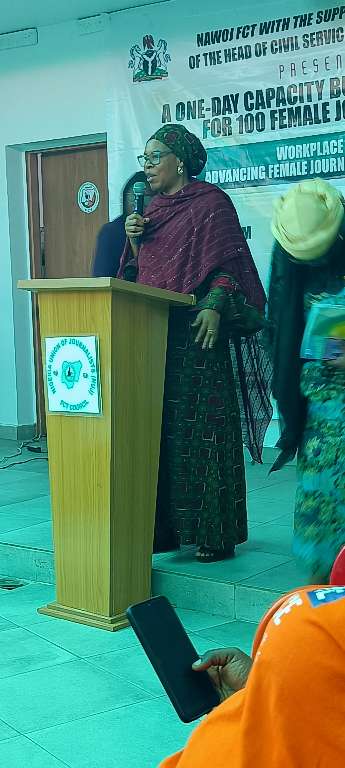
At the One-Day Capacity Building Training for 100 Female Journalists themed “Workplace Diversification: Advancing Female Journalists’ Role in the Newsroom,” the hall grew still when Hajiya Zainab Okino, Chairman, Editorial Board of Blueprint Newspaper, stepped forward.
She didn’t begin with a quote, theory or statistics. She began with a confession raw, emotional, and piercingly honest.
“I only came here to speak from experience,” she said, scanning a room full of women whose eyes already told the story, determination, exhaustion, humour, frustration, resilience. And above all, survival.
What followed was a masterclass in truth-telling, beat by beat, about the political, professional, and personal minefields female journalists navigate in Nigeria.
Hajiya Zainab laid it bare: journalism is not just a career; it is “a calling that summons you at morning, afternoon, and night” and she emphasized night, not evening.
It is a profession that:
snatches your time
drains your body
stretches your mind
reshapes your family life
and re-arranges your priorities
She likened the demands to the unpredictability of a medical doctor on emergency duty. Breaking news doesn’t consult your schedule, your child’s fever, or your emotional bandwidth.
But for women, she said, the stakes are brutally higher.
Zainab reminded the audience that the newsroom does not exist in isolation from society.
Female journalists particularly mothers carry a dual weight:
deadlines and domestic responsibilities
breaking news and broken marriages
office pressure and societal expectations
career ambition and childcare dilemmas
Many women, she said, lose assignments, opportunities, even promotions simply because they are expected to prioritize home, always.
A journalist might be called for an assignment at noon, yet by 4pm she is still stuck juggling police reports, interviews, and logistics, while knowing her baby is home waiting for her. But the job demands results, not excuses.
And the penalty for missing one assignment? Future opportunities quietly disappear.
She called this silent punishment “the invisible and hostile mindset” against women.
Then she delved into what she called journalism’s most toxic undercurrent: perception.
Female journalists are still battling:
stereotypes that paint them as “easy,”
condescending labels that reduce them to caretakers,
newsroom gossip that questions their professionalism,
and editors who assign them only soft beats, women, children, lifestyle.
She challenged the room:
“Why are women automatically handed the women-and-children beat? Can women not cover politics, security, business, or investigations?”
She reminded them that while men bond in press centres, drinking and forming alliances, women are judged for even showing up in such spaces.
Yet refusing to join these informal circles often leads to exclusion.
A no-win situation baked into newsroom culture.
Zainab raised the alarm on the normalization of harassment.
She narrated cases of female reporters who were bypassed for assignments, accused falsely, bullied, or emotionally abused, yet unable to speak because “they don’t want their careers to die before they start.”
Her organization, she explained, tries to intervene discreetly, balancing compassion with policy.
But she warned: “If life draws a line you cannot cross, do not remain silent.”
Her tone shifted as she discussed the personal cost of the profession.
She told the story of a woman whose husband took a second wife because “she was never at home” yet the new wife refused to raise the children.
Chaos followed.
The career suffered.
The marriage collapsed.
“Choose your partner wisely,” she advised. “Some people pretend until marriage happens.”
She listed the questions every female journalist must ask:
Will he support my career?
Will he withstand gossip from friends and relatives?
Will he understand late-night duties?
Or will he punish me for them?
Her conclusion was unmistakable:
The wrong spouse can derail a career faster than bad newsroom politics.
Zainab urged the women to safeguard their integrity:
Avoid newsroom gossip networks.
Respect your own image.
Arrive early.
Keep to time.
Represent your organization with dignity.
“People judge women harshly,” she said. “If a man comes late, they’ll say he had a rough day.
If a woman comes late, they’ll say she is unserious.”
She did not hide the spiritual dimension of survival. “Prayer is not performance; it is an anchor,” she said.
She encouraged women to build strong support systems:
spouses
siblings
domestic help
older female colleagues
sisterhood networks
She urged young journalists to seek mentorship, revealing that countless young women had cried in her office over heartbreak, exhaustion, sexism, and impossible expectations.
“I tell them: Cry if you must. Cry, and then rise.”
Zainab cited surveys showing that many journalists consider quitting due to:
long hours
poor welfare
burnout
lack of promotion
family strain
She emphasized that Nigerian female journalists rarely get the luxury of taking years off for childbearing, unlike in other countries.
Instead, they navigate pregnancy, childbirth, and breastfeeding—with a microphone in hand and a deadline a few hours away.
After exposing the cracks, Zainab delivered her final verdict:
Yes, journalism is demanding.
Yes, it discriminates.
Yes, women must work twice as hard.
But journalism is still one of the most rewarding careers on earth.
It opens doors.
It expands your mind.
It gives you access to power and influence.
It builds networks that last a lifetime.
And with the right environment, she said, women will not just survive, they will lead.
Her closing words carried the weight of experience:
“Journalism is an exceptional career. And women, given the right support, will excel beyond expectations.”
The hall erupted not in applause alone, but in recognition.
The truth had finally been spoken.