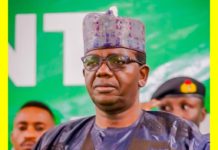
Matawalle: This is sovereignty, not symbolism.
By Joy Odor, Abuja
The Tinubu administration has opened a new political and industrial front in its drive for economic sovereignty, signing a landmark pact that could redefine Nigeria’s security and industrial balance of power.
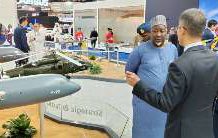
In a move analysts describe as both strategic and symbolic, the Federal Government has formally launched a plan to end decades of dependence on imported weapons and transform Nigeria into a regional defence manufacturing hub.
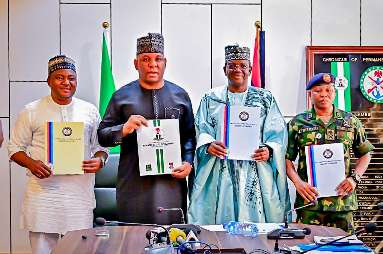
At the centre of this initiative is an alliance between two state giants — the Defence Industries Corporation of Nigeria (DICON) and the Ajaokuta Steel Company Limited (ASCL) sealed through a Memorandum of Understanding (MoU) signed in Abuja on November 9, 2025.
Presiding over the event, Minister of State for Defence, Dr. Bello Matawalle, said the partnership marks the beginning of a new era in which Nigeria will “no longer beg for bullets” but will instead build its own arsenal from locally sourced materials.
“For too long, we’ve relied on foreign suppliers for equipment to defend our sovereignty,” Matawalle declared. “President Bola Ahmed Tinubu’s Renewed Hope Agenda is about reversing that mindset. This is not just an industrial project, it’s a statement of independence.”
Political observers say the move is as much about domestic legitimacy as it is about national security.
By placing defence manufacturing at the heart of his industrial strategy, President Tinubu is tightening the link between economic revival and military self-sufficiency, a narrative that resonates with his broader political promise of “Renewed Hope” amid tough economic reforms.
Minister of Steel Development, Dr. Audu Abubakar, described the agreement as a political reawakening of Ajaokuta, long regarded as the graveyard of Nigeria’s industrial ambitions.
“Ajaokuta is no longer a sleeping asset, it’s becoming a cornerstone of national defence,” Audu said. “Our workshops will soon begin producing helmets, vests, bullets, and rifles. We’ve also set aside land for a Military-Industrial Complex that will serve as the nucleus of our defence industry.”
The initiative aligns with the government’s push to localize security spending, reduce foreign exchange pressure, and create jobs in strategic industries.
Senior defence insiders say the long-term goal is to position Nigeria as the continent’s primary defence hardware producer, competing with Egypt and South Africa in arms technology and steel-based innovation.
Beyond the economics, the political message is clear: Tinubu is reclaiming Ajaokuta not only as an industrial hub but as a symbol of functional governance after decades of stalled promises.
At the signing ceremony, attended by top military Chiefs, industry regulators, and party loyalists, both ministers praised the President’s “political foresight” and “executive synergy” in aligning ministries that historically worked in silos.
“This is not business as usual,” Matawalle said. “We are building an economy that can defend itself.”
The MoU, officials say, will pave the way for a homegrown defence-industrial ecosystem, capable of serving Nigeria’s security agencies and eventually entering export markets.
It also positions the administration to showcase concrete achievements ahead of 2027, a political dividend for an economy still adjusting to painful reforms.
By tying defence production to Ajaokuta’s revival, the Tinubu government is effectively weaponising industrial policy, merging steel, sovereignty, and statecraft into one political statement.
In doing so, it sends a signal to foreign suppliers and domestic critics alike: Nigeria’s next phase of power may be forged, quite literally, in steel.