By Joy Odor
President Bola Ahmed Tinubu has emphasized the need for West African leaders to drive economic growth through vision, integration, policy coherence, collaboration, and capital alignment.
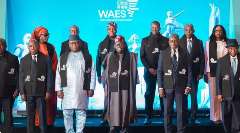
Speaking at the inaugural 2925 West Africa Economic Summit (WAES) in Abuja, Tinubu noted that opportunity alone cannot guarantee transformation.
Tinubu highlighted that intra-regional trade in West Africa remains below 10%, attributing this to coordination failure rather than a lack of will.
He stressed the importance of strengthening regional value chains, investing in infrastructure, and coordinating policies to drive growth and development.
Tinubu emphasized the region’s youthful population as a significant asset, but noted that investments in education, digital infrastructure, innovation, and productive enterprise are necessary to unlock their potential.
He emphasized the need for governments to provide an enabling environment while the private sector drives growth, highlighting the importance of collaboration between governments, industry, and stakeholders.
Tinubu warned that the global economy would not wait for West Africa to get its act together, emphasizing the need for urgent action to drive economic transformation.
He highlighted the region’s possession of rare minerals vital to new industries, stressing the need to invest in local processing and regional manufacturing to turn mineral wealth into domestic economic value.
Tinubu called for investment in transport and other economic infrastructure to support prosperity growth, emphasizing the importance of collaboration and collective action.
Other leaders who spoke at the summit, including the Minister of Foreign Affairs, Ambassador Yusuf Maitama Tuggar and the Presidents of Sierra Leone, Niger, and Liberia, also emphasized the importance of regional integration, economic development, and collaboration in driving growth and prosperity in West Africa.
The Minister of Foreign Affairs (MFA), Ambassador Yusuf Maitama Tuggar called for a reset in West Africa’s economic vision, emphasizing the need to leverage the region’s vast resources to drive growth and development.
Tuggar highlighted the region’s potential and the importance of collaboration among member states and stressed the need for West Africa to build a better future through shared histories and proud traditions, leveraging its scale, talent, and critical mass to drive profound changes.
The Minister emphasized the importance of turning mineral wealth into domestic economic value through local processing and manufacturing, citing the region’s possession of rare minerals vital to new industries.
The Executive Vice Chairman/CEO, National Agency for Science and Engineering Infrastructure (NASENI), Khalil Suleiman Halilu, opined that the ideal for the region would be further integration from a political and economic perspective.
According to him, ECOWAS is a perfect example of regional integration, but unfortunately is in conflict, saying this should not paralyze us and prevent us from going to the essential, which is a real need for the integration of our communities, at least economically.
“This summit is being renamed because our region is going through a crisis of trust and established partnerships. This summit is in perfect timing as our regions come together for further integration.
“The only issue that we face is that we are not able to realize our ideas. And our main failure, which is the cause of our underdevelopment, is our inability to put our ideals into practice.
In her contribution, Hon. Babucarr Qusmaila Joof, representing President Adama Barrow of Gambia affirmed that the global economy is currently shaken by multiple crises, from geopolitical tensions and a unilateral increase of customs tariffs, which are distructing international trade, given to the development of certain economies in the West African region.
Joof explained that West Africa is one of the regions with the highest return on investment in the world, noting that the mechanism must be put in place to showcase its enormous potential and to provide the right incentives and support to African investors.
She also told them to collectively find ways to remove obstacles that are fully preventing commercial integration and opportunities, saying unleashing trade investment potential requires proactive strategies as the outset to eliminate all barriers to trade, and to support regional businesses.
In his remarks, the President of Sierra Leone, Maada Wonie Bio lamented that the West African potential must be unlocked through strategic integration, especially in the light of rising public debt, climate vulnerability, food insecurity, and geopolitical uncertainties affecting their economies.
According to him, the Trade integration must start with a strong political commitment from all Member States while engaging in key regional initiatives, such as the ECOWAS trade, the collective liberalization scheme to reduce tariffs and barriers, and the common external tariffs to harmonize trade policies.
President Maada challenged all West Africa leaders as a matter of urgency accelerated progress towards monetary union, pointing out that a single regional currency would reduce exchange rate costs, and increase the number of foreign currencies in the world.
President of Sierra Leone also ascertained that there is a need to adopt innovative financing models to develop essential infrastructure, like roads, rail, ports, air transport systems, which will enhance connectivity, reduce logistic costs, and facilitate the movement of its people and goods in the sub-region.
He confirmed that strengthening regional stock exchanges and harmonizing capital markets is essential also for enhancing financial integration and unlocking investment flow.
Also, Abdourahamane Tchiani, the President Niger said President Tinubu called for a common action for the complementarity and integration of its economy, which is based on the role of the heads of state is to be saluted which is why the efforts towards regional integration should be commended.
He mentioned that the ideal is to have a regional integration that concerns the economy, security, politics, democracy and freedom but the need for an economic integration is indispensable.
President Tchiani charged all West African communities and to those who are in charge of implementation of policies to be aware and reinforce the renewal that is necessary within the ECOWAS region from the leadership perspective.
In his speech, the Liberia President Joseph Boakai echoed an appeal for West Africa to keep the door open for engagement and reconciliation, especially to assist the state that unfortunately has hit.
According to him, with Liberia’s ascension to the Security Council, it’s determined to be the principal voice of the region, advocating for just solutions to global and regional challenges and advancing the values that unite them.
He commended each State for their steadfast leadership and for efforts they continued to make in advancing the goals of economic integration and prosperity.
President Boakai called on all the Heads of State to seize the opportunity to deepen collaboration, mobilize their collective resources, and transform the potential of their region into lasting projects for their people.
He assured that Liberia remained fully committed to promoting productive sub-regional interaction, peace, national cohesion, and democratic governance throughout the region.
The Liberia President also informed that its government would continue to avail ourselves of the ECOWAS community and critical areas of mediation, conflict prevention and post-crisis stabilization.
The West Africa Economic Summit provides a platform for leaders to discuss and address the region’s economic challenges and opportunities.
By working together and leveraging their collective resources, West African leaders can drive economic growth and development, creating a more prosperous future for their citizens.