By Joy Odor – Report Circle, Abuja
The political battle for space, representation and influence inside Nigeria’s newsrooms took centre stage in Abuja on Tuesday as the Nigeria Association of Women Journalists (NAWOJ) unveiled one of its most assertive pushes yet for gender diversification in the media sector.
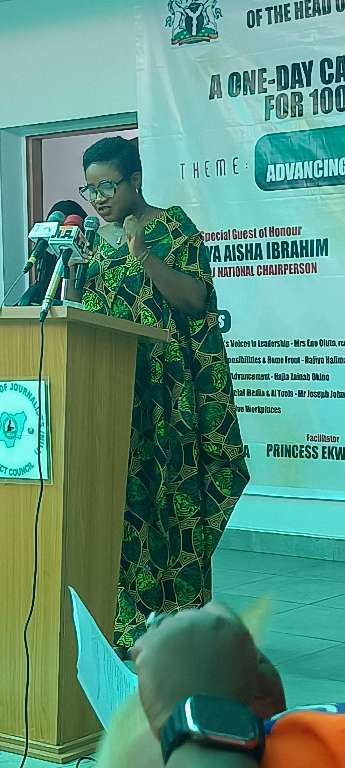
At a one-day capacity-building summit for 100 female journalists hosted under the theme “Workplace Diversification: Advancing Female Journalists’ Role in the Newsroom” NAWOJ National President, Comrade Aisha Ibrahim made it clear: journalism in Nigeria cannot claim credibility while women remain underrepresented at decision-making levels.
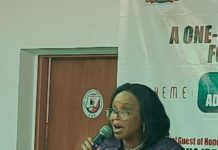
Represented by the Chairperson of the Nigeria Union of Journalists (NUJ) FCT Council, Comrade Grace Ike, the NAWOJ National President issued a message that blended humour with hard political truths: women are no longer waiting to be included, they are organising to reshape the industry.
Grace Ike’s delivery started lightheartedly with jokes that “women can do everything, except maybe,” sparking laughter. But beneath the humour was a political undercurrent: women journalists carry twice the labour for half the reward, and the imbalance is structural, not accidental.
“Women are great. Our gender is our strength, not our limitation,” Ike declared, setting a tone that fused solidarity with urgency.
Reading the NAWOJ President’s remarks, Ike stressed that newsroom diversification is no longer a corporate formality, it is a political necessity.
Not a slogan.
Not an aspiration.
Not a statistical target.
A necessity.
She argued that a diversified newsroom strengthens democratic accountability by ensuring that the stories shaping public opinion are produced through a gender-inclusive lens.
“Diversification means equitable influence, not just numbers,” she said. “It means women sitting at decision tables not waiting outside the door.”
In a media environment that shapes electoral behaviour, national sentiment and public policy, NAWOJ positioned diversification as a democratic issue not a gender grievance.
NAWOJ’s agenda, as laid out by the President, cuts across four political battlefronts:
Dismantling institutional barriers that limit women’s participation.
Fighting for equitable editorial representation in powerful beats like politics, security and economy.
Equipping women with strategic communication and leadership tools to compete for top editorial roles.
Challenging old newsroom stereotypes that confine women to “soft news.”
“This training,” the President noted, “ensures no female journalist feels less deserving or less capable in a profession that should reward merit—not gender.”
The President urged participants to embrace:
Negotiation skills for leadership roles
Digital strategies that enhance influence
Communication techniques that shift newsroom narratives
“Everything we do today is strategy,” she said. “If you are learning a skill, let it be strategic. If you are negotiating a role, do it confidently not quietly.”
Her message underscored a wider political truth: newsroom leadership is a contest for power, and women must enter that contest equipped.
The event was framed not just as training but as a turning point:
A day of networking
A day of learning
A day of renewed professional commitment
A day of political awakening within the media sector
“The newsroom is not just a workplace, it is a venue for gender equality and professional advancement,” she reiterated.
The room responded with the kind of applause reserved for messages that touch both personal and political nerves.
As her remarks drew to a close, Ike honored the women who have mentored younger journalists, fought silent battles, and refused to accept token inclusion.
For NAWOJ, this training is not a one-off workshop.
It is strategy.
It is political organising.
It is legacy-building.
It is resistance.
And, more importantly, it is a blueprint for a media sector that reflects the country it informs.
When the applause finally settled, one truth was unmistakable:
Women journalists in Nigeria are no longer merely participating in the newsroom, they are actively reshaping its politics.
Confidently.
Strategically.
Together.